

afterword
This Is Not a Test: The Definitive Edition is available now.

The 2012 edition of This Is Not a Test was the last of my books my father lived to see. Its dedication is to him, and borrows a line from a letter he wrote to my mother in the year he died: It is not my expectation to change the world. I want to change my life. I was struck by how perfectly it positioned the narrative’s grief, and how it became a space within the novel to hold mine.
The inspiration for its story is well documented elsewhere, but the abridged version is this: I watched George A. Romero’s Night of the Living Dead at too young an age, and was left so disturbed by the relentlessness of its dead, and its cruelly indifferent ending, that it catalyzed a lifelong love and obsession with zombie stories, eventually compelling me to write my own.
It’s my fourth book, published at a time in my career I was establishing myself as an author who specialized in exploring the brutal realities of the lives of teenage girls. I was known for “unlikable” female main characters who defied expectations and expanded the definitions of what fictional girls could do and be in the pages of YA. The sudden addition of zombies to that equation would prove less a pivot than some anticipated—in fact, it only seemed to cement the perception.
At the heart of the novel is Sloane Price, a traumatized young woman whose feelings about the end of the world are complicated, to say the least. The day the dead come back to life, she’s planning to die. In the ensuing chaos, she ends up trapped inside her high school with a handful of classmates, forced to observe the apocalypse through the eyes of people she believes have more reason than her to live. But the group’s negotiations for survival are greatly impacted by the individual losses they’ve endured and the threat of future losses.
Since This Is Not a Test’s original publication, I’ve endured more losses. They have expanded my understanding of both the painful and the beautiful ways death animates our lives. My perspective on grief has evolved, and where I might once have only seen it reflected in Sloane, I recognize it in the book’s other characters now too: Cary, Rhys, Trace, Harrison, and Grace.
In 2024, I reclaimed the rights to the majority of my backlist titles. It was an empowering and somewhat fraught experience, wiping what was nearly my entire bibliography off the board. The abiding logic is authors want their books widely available to be read. But these books, in particular, were so beloved by their readers that despite the risk and uncertainty, I felt it was a necessary move if I wanted to pursue future possibilities in which I could effectively honor both—the audience and the work. I had no immediate plans to pursue republication, but deeply unsettling cultural and political shifts threatening the rights, bodies, safety, and autonomy of women and girls created an increasing sense of urgency in me, and my literary agent and I began to actively explore my options. So long as the books and their intended audience felt well cared for, I was open to most approaches, whether that meant republishing the backlist in whole or in part, traditionally or independently.
As we moved forward with a proposal to a select group of publishers and editors I respected and admired, something unexpectedly wonderful was also occurring: This Is Not a Test had been optioned for a movie years prior, and it seemed likely it would happen. Then it was more than likely—it was definitely happening. There was a cast, the shoot had been scheduled, press releases were being drafted, preproduction had begun . . . but when the movie was released, would readers be able to obtain the book it was based on?
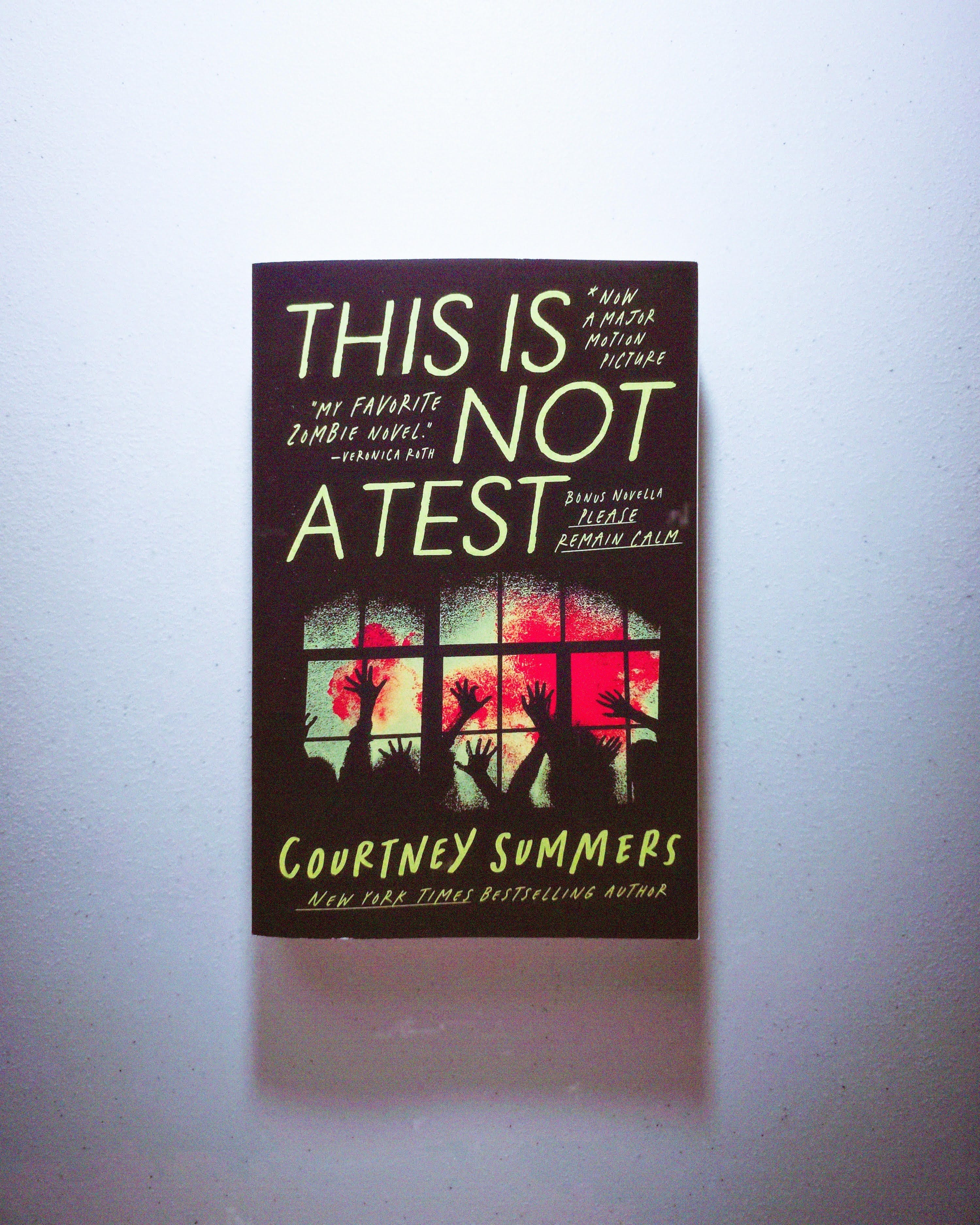
Happily, today’s publication of the definitive edition serves as the answer to that question. It’s been such a professionally and creatively fulfilling experience to have connected with Bindery Books and Kathryn Budig under her Inky Phoenix Press imprint to bring this new edition to shelves. Kathryn has infused every part of this experience with a level of enthusiasm and conscientiousness that is unparalleled. She is a deeply thoughtful and incredibly clever publishing partner, and I have such great admiration for her approach to books, to their readers, to her community, and most especially for her vision for an industry that is stubborn and slow to change. It’s been a privilege and honor to work with someone so committed to their artistry in every form it takes. Kathryn is an artist.
Each part of this publishing process has been marked by an understanding and respect for its story, and for the readers who will need it the most. For all its zombies, This Is Not a Test is a very human narrative about the ways in which both ordinary and extraordinary circumstances can be defined and redefined by trauma, and the ways those circumstances can define and redefine trauma itself. It’s about finding meaning and hope when there’s little left to draw from. It’s about uncertainty, and how we respond to it. We go through bad times hoping, eventually, to arrive at the good. This Is Not a Test is about moving through the world without that promise, the ways in which we occupy our here and now, and how there are always choices to care for ourselves, for one another.
This Is Not a Test was written when I was twenty-five. In the fifteen years between then and now, I’ve released four more books. My writing has improved with each of them. This, I believe, is the job of the author: to get better at it every time. Each outing is an opportunity to further hone your craft, developing new strengths to conquer what the work reveals to be your present weaknesses. When you finish, the challenges of the next book emerge from your victories over the last. The end result of every effort is, ideally, the best book you could have written at the time.
This Is Not a Test was the best book I could have written then, and I’m very proud of it. But it was always my intention to further empower the reclamation of my backlist by substantively refreshing those texts—their “Taylor’s Versions,” if you will. There was something enticing about the idea of introducing my past and present author selves and seeing where their conversation led them, and inviting readers, past and present, along for that ride.
This edition of This Is Not a Test comprises eleven total passes. The first was to get reacquainted with the story and its world. I found I loved Sloane and company just as much as I had when I initially dreamed them up. The writing itself very much exemplified an earlier state of my artistry. I saw the stylistic choices that made the book’s voice so raw and impactful and uniquely mine. I could also see rough edges that needed to be more refined.
Something that’s been said of my earlier novels is how intensely they inhabit the minds and feelings of their main characters. I believe this is most reflected in their aggressively stream-of-consciousness narration, their fast and furious flow of thought that rarely pauses for breath. Over the course of the ensuing passes, I learned I could not replicate the author I was in that moment in my creative history and that I would have to be careful to distinguish between what was raw and what was rough and revise accordingly. Its raw edges were what made the book special to so many of its readers, and they were important to preserve. Its rough edges needed to be addressed for the sake of enriching that reading experience.
In revisiting This Is Not a Test, I understood I was not here to prove I was a better writer now than I was then, that the point was not to turn every sentence into some kind of technical achievement. The point was to go deeper into the world of the dead and use every tool in my kit to make it feel more alive. The writer I had become had to earn her place back into its story.
The key to this was a willingness to confront and mine my own losses, starting with the death of my father through to, most recently, the death of my beloved grandmother. Each of those losses gave as much as they took from me—and never in exactly the same way.
Where Sloane internalizes and acts on her grief in a very specific manner, it’s always in concert with the loss and grief of others, and their losses demanded a greater specificity as well. My father’s words came back to me: It is not my expectation to change the world. I want to change my life. That in mind, I began reworking the book in earnest, looking closely at each of its lives, and what of them could be changed.
The preferred text is less about transforming what happens within the story than it is about digging in to the way the perspectives of and relationships between its characters, and their traumas, are expressed. While I intend to leave the majority of these expressions to be discovered by readers, whether with or without foreknowledge of the original text, here are just some of the decisions I made that enhanced the novel (with gratitude to Kathryn Budig for her guidance in helping me to more fully live in its details):
The opening chapter better illustrates the impact, both subtle and overt, of Sloane’s daily life growing up with an abusive father. Those dynamics, and that history, have been more viscerally framed throughout. Sloane’s relationship with Lily has also taken on greater contours, and so has Lily herself—readers will be rewarded with certain insights should they interpret Cary’s arc as somewhat analogous to hers. I’ve brought Sloane and Grace’s relationship more to the fore, and a natural extension of that was Grace coming more into her own as a character. Their sleepover is an anchor to which Sloane clings in both versions, and I hope its importance is even more felt by readers now. Something I was struck by as I revised was the push and pull between Sloane’s emotional intensity and remove as a result of her trauma. I took greater pains to explore her coping mechanisms to highlight the precarity of her mental and emotional state. Sloane’s continued commitment to life is never a given, even by the book’s end, but I hope her journey suggests someone who is, moment by moment, rejecting death a little more each time.
This Is Not a Test is joined by the novella sequel, Please Remain Calm. Originally published as an ebook only, its revision was considerably lighter and made less demands, but astute readers might find the answer to a certain question waiting at the end of it. But don’t ask me to say it outright—I’ll never tell. The space after a last sentence is one in which anything could happen . . .
I could not have imagined that fourteen years after its original publication, I would release a new edition of This Is Not a Test under the umbrella of an exciting new publisher, with a movie adaptation bound for theaters. What I owe my work is everything and what I want for it is everything, but neither entitles me to anything, and I’m so grateful to have been given the gift of this particular experience at this point in my career. I hope you’ve enjoyed reading these stories—whether or not it was for the first time—as much as I’ve enjoyed writing, revisiting, and preparing them for you. The support and generosity of readers has been a constant throughout my creative life. There are plenty of books out there to choose from. Thank you for choosing mine.
This was a great read, I love this book and I am really chewing on this: "I learned I could not replicate the author I was in that moment in my creative history and that I would have to be careful to distinguish between what was raw and what was rough and revise accordingly."
It's so easy for us to tell ourselves we shouldn't indulge in the creative instincts we had when we were younger-- but a lot of those instincts were spot on. Discerning which ones to let go of and which ones to hold tightly is hard work.
I love hearing about this process of reclaiming the work. I like to look back and read my early work, but, honestly, I would be a little scared of disassembling or editing it in any way. What a feat!